Individual knee implants
designed automatically from CT data
Patient-specific implants adapt to the patient's anatomy and require the removal of less healthy
bone tissue, which can improve the chances of recovery, durability, and quality of life. Despite
these advantages, standard implants are usually preferred, because designing custom endoprostheses
is laborious and costly: the external geometry, such as the rolling surfaces and outer dimensions,
has so far largely been derived by hand from the imaging data.
The goal of EXPERTEB was to make an individual knee implant competitive in clinical routine, and
indeed the preferred choice, by simplifying and accelerating the design process through automation
and suitable interfaces. In the long term, the physician should be able to shape the implant
largely according to their own ideas, without having to rely on a technical expert.
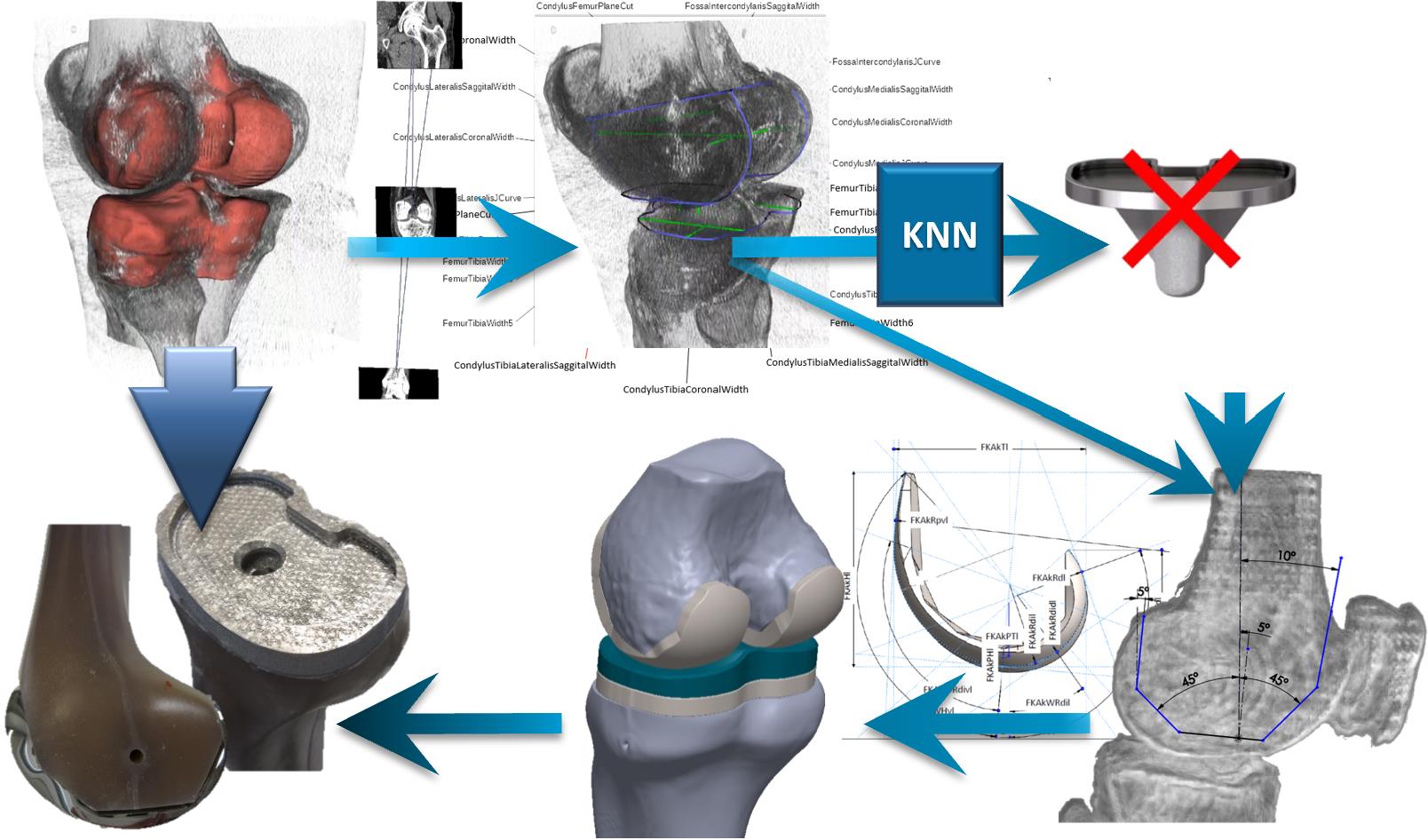
The approach: a Statistical Shape Model
At the heart of the subproject carried out by Dornheim (WP 1) is a Statistical or Active Shape Model
(SSM/ASM) that segments the femur and tibia from the patient's CT data as separate 3D models.
Measurement objects are linked to the model and automatically supply the geometric parameters for
the external shape of the individual implant. By adapting the model to a slightly idealized,
healthier bone shape, the individual outer dimensions are obtained and handed over to the partners
via a defined interface.
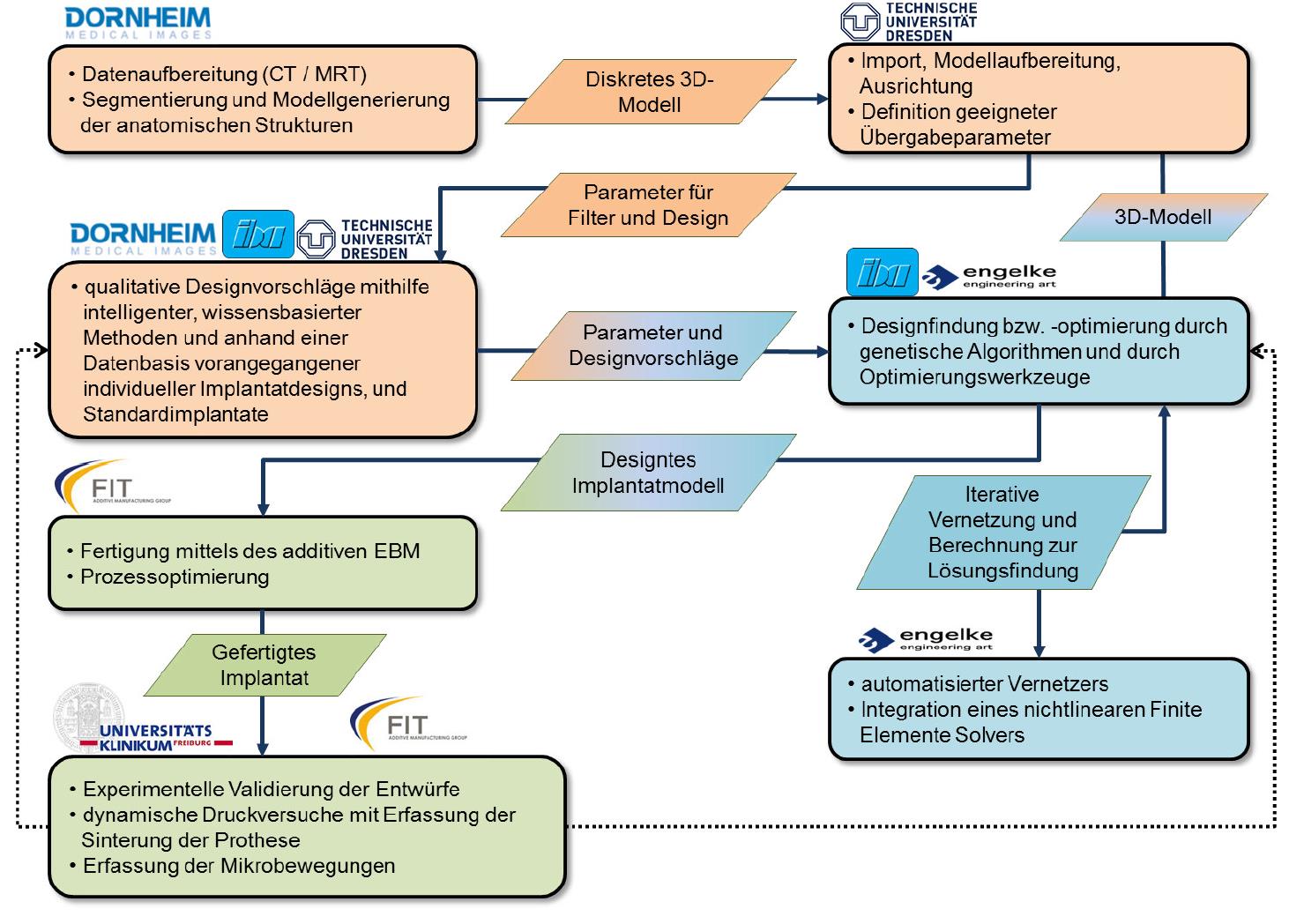
The determined parameters then feed into a parametric unit model (TU Dresden) and into an
artificial neural network (iba) that computes the internal geometry, such as the length of the
stem. In this way, an individual implant design emerges hand in hand and is handed over to the
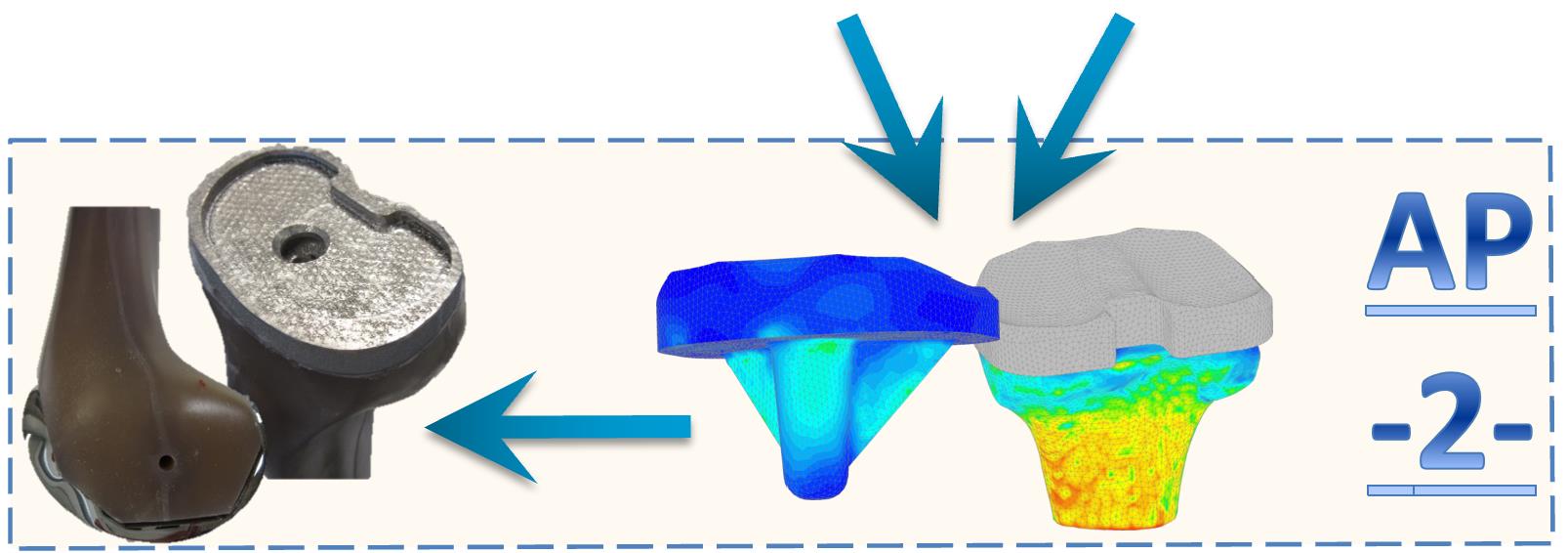
biomechanical optimization (WP 2) and the additive manufacturing (WP 3). A uniform coordinate
system ensures reproducible, comparable results across all cases.
Accuracy, efficiency, and image quality
For clinical use, accuracy and speed are decisive. The segmentation must match the real bone
contour with a tolerance of about one millimeter, derived from the tolerances customary when
inserting standard implants. To reduce noise without blurring the object edges, a guided filter
was used instead of the computationally intensive bilateral filter; it smooths while preserving
edges and within an acceptable time.
For datasets that match the training data, the manual effort is on average well below the targeted
30 minutes: in the demonstrator, only the position of the bone is marked, and the procedure handles
the rest largely autonomously. Because the model is continuously trained further as the data base
grows, the results improve over time.
Contributions by Dornheim Medical Images
Dornheim took on the overall coordination of the consortium and carried out WP 1: the automated
segmentation and 3D modeling of the anatomical structures, intuitive interaction and correction
tools for quality control, knowledge-based methods for selecting a base implant, as well as the
design of an extensible implant library and the required interfaces. Building on the Dornheim
Segmenter®, matured over many years, a demonstrator was created from several interacting modules.
The methods developed feed into the Dornheim.Cloud and into specialized modules of the Dornheim
Segmenter, and in the direct follow-up project
OptiKneeBM
they were extended to include the design of the associated cutting and drilling guides.